
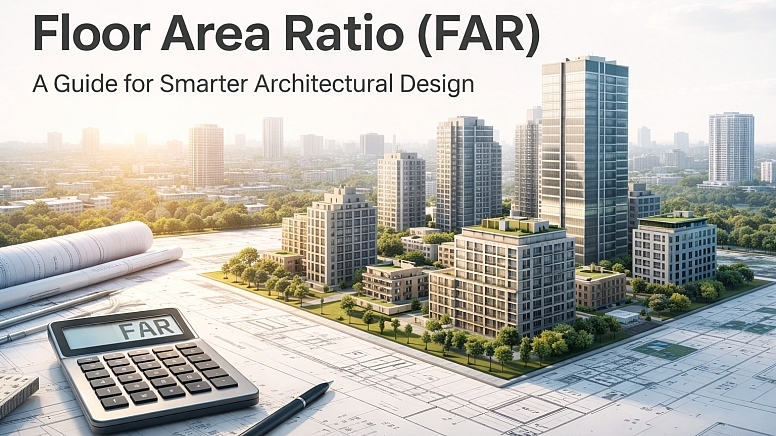
Floor Area Ratio (FAR): A Guide for Smarter Architectural Design
Floor Area Ratio (FAR) is one of the most influential planning controls in architecture and urban development. It determines how much built floor space is permitted on a site — directly shaping building height, density, massing, and overall project feasibility.
At SAO Architects, we help clients understand and strategically apply FAR to unlock a site’s full design and economic potential.
What is floor area ratio?
Understanding FAR
Floor Area Ratio (FAR), also known as Floor Space Ratio (FSR), measures the relationship between a building’s total floor area and the size of the plot on which it is built.
Formula:
FAR = Total Gross Floor Area ÷ Site Area
Example: If a site is 1,000 m² and the total floor area of the building is 2,000 m², the FAR is 2.0.
Tip: FAR counts total floor area across all levels, not just the footprint — meaning vertical design choices are critical.
What counts toward FAR?
Not all spaces in a building are always included in FAR calculations. Understanding what counts can help avoid surprises with local zoning rules:
- Typically included: All enclosed, habitable floors such as residential, commercial, or office spaces. Multi-level floor areas are counted individually.
- Typically excluded (may vary locally): Basements or underground parking, open terraces or roof gardens, mechanical rooms, and service shafts. Check your municipality’s rules for specifics.
Local zoning definitions vary, so it’s important to confirm which areas are counted toward FAR for your project.
Why FAR matters in architecture
FAR is more than a number — it shapes cities, streetscapes, and buildings.
Density control
Higher FAR values allow greater intensity of use, while lower FARs maintain lower-density, open environments.
Building form and massing
FAR influences whether a building grows:
- Horizontally (larger footprint)
- Vertically (more storeys)
- Through mixed-use stacking
Environmental quality
By regulating bulk and volume, FAR supports access to daylight, ventilation, open space, and overall livability.
FAR in practice: what it means for your project
Site planning
FAR defines:
- Maximum buildable area
- Number of floors
- Functional layout possibilities
Design efficiency
Smart architectural solutions can maximize usable space while remaining compliant, including:
- Compact floorplates
- Efficient circulation cores
- Stepped or articulated massing
Development value
FAR directly affects:
- Yield
- Leasing or sale potential
- Return on investment
FAR by zoning type
| Zoning type | Typical FAR range |
|---|---|
| Low-density residential | 0.5 – 1.2 |
| Medium-density residential | 1.5 – 3.0 |
| Commercial / mixed-use | 3.0 – 6.0 |
| High-density urban core | 6.0 – 10.0+ |
Note: FAR regulations vary by municipality and are often combined with height, setback, and open space controls.
Calculate your floor area ratio: Use our FAR calculator
Want to quickly understand what your site allows?
Use the SAO Architects FAR Calculator in either basic mode for simple FAR calculations or advanced mode for more detailed projects.
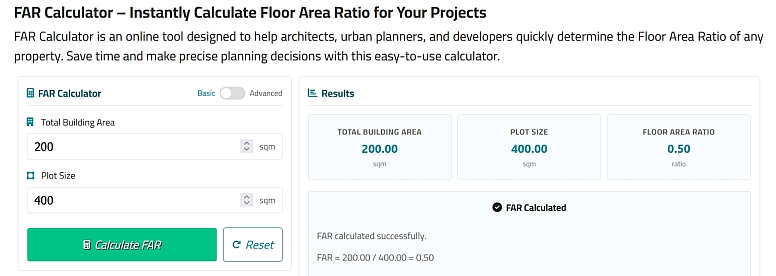
Our calculator is a handy tool which helps you:
- Instantly compute FAR
- Test design scenarios
- Make informed early-stage decisions
Pro insight: A compliant FAR doesn’t guarantee approval — design quality and context still matter.
SAO Architects’ approach to FAR
At SAO Architects, we treat FAR as a design opportunity, not a constraint. Our process includes:
✔ FAR feasibility studies ✔ Early massing and yield analysis ✔ Planning code interpretation ✔ Design optimization within regulations
We ensure each project balances compliance, creativity, and commercial viability.
Floor Area Ratio is a foundational element of responsible, high-quality architecture. When understood and applied strategically, FAR can enhance design outcomes, improve urban environments, and maximise site value.
If you’re planning a new project or assessing development potential, SAO Architects is here to guide you every step of the way.
FAQs about Floor Area Ratio (FAR)
1. Does a compliant FAR guarantee project approval?
No. Meeting FAR limits is just one part of zoning compliance. Authorities also evaluate height restrictions, setbacks, open space requirements, design quality, and environmental or historical considerations before approving a project.
2. How do I handle local variations in FAR rules?
FAR regulations differ between cities, neighbourhoods, and zoning districts. Always check your municipality’s zoning code or consult with a local architect or planner to confirm what counts toward FAR and the maximum allowable values.
3. How can architects strategically plan around FAR?
Architects use FAR as a design tool. Strategies include compact floorplates, stepped or articulated massing, vertical stacking, or mixed-use layouts. These approaches maximize usable space while staying compliant and improving the building’s form and function.
4. How does FAR affect property value and investment?
Higher FAR allows more buildable space, which can increase the development potential and financial return of a property. Conversely, a lower FAR may limit building size, density, and potential yield. Developers and investors often factor FAR into feasibility studies and project valuation.
5. Are there limitations to online FAR calculators?
Yes. Calculators provide estimates but may not account for all local zoning nuances, such as excluded areas, floor plate restrictions, or special overlays. They’re best used for preliminary planning — always confirm calculations with local regulations and professional advice for complex or large-scale projects.
LEAVE A COMMENT
Recent Posts






0.0689