
44% of Architects Use AI Renders: Here's Why It's a Problem
A few months ago, a developer sent me a set of "renders" they'd been using to market a residential project. The images were stunning; golden-hour light pouring through floor-to-ceiling windows, lush landscaping, immaculate interiors with that dreamy atmospheric haze that makes everything look like a boutique hotel in Tulum.
The problem was that none of it was real. Not in the sense that all renders represent unbuilt spaces; I've spent seven years doing exactly that. The problem was deeper. The images had been generated with Midjourney. There was no 3D model behind them. No actual floor plan is driving the proportions. No material specification is provided for the surfaces. The ceiling heights were physically impossible. The window mullions didn't match the engineering. The "kitchen" had a layout that would violate building code in any jurisdiction I know of.
The images were gorgeous. They were also architectural fiction. And the developer didn't see the problem.
The Flood Is Already Here
If you haven't been paying attention, here's where things stand in 2026. According to the Chaos State of ArchViz Report, 44% of architects now use AI for concept images. Midjourney costs $10 a month. A developer with no design background can generate a "render" of a luxury apartment in thirty seconds that, at first glance, looks indistinguishable from a $3,000 studio-produced visualization.
I'd be lying if I said this doesn't worry me commercially. It does. But the commercial threat isn't actually the interesting problem. The interesting problem is what happens downstream, when buyers start encountering these images in sales materials.
Because here's what AI-generated architectural images can't do, and it's not a minor limitation. They can't represent a specific building. Midjourney doesn't know your floor plan. It doesn't understand your structural grid. It can't simulate how light enters your actual windows at 3 pm in November. It doesn't know that your specified porcelain tile has a cool undertone that will read completely differently from the warm marble it hallucinated into the image.
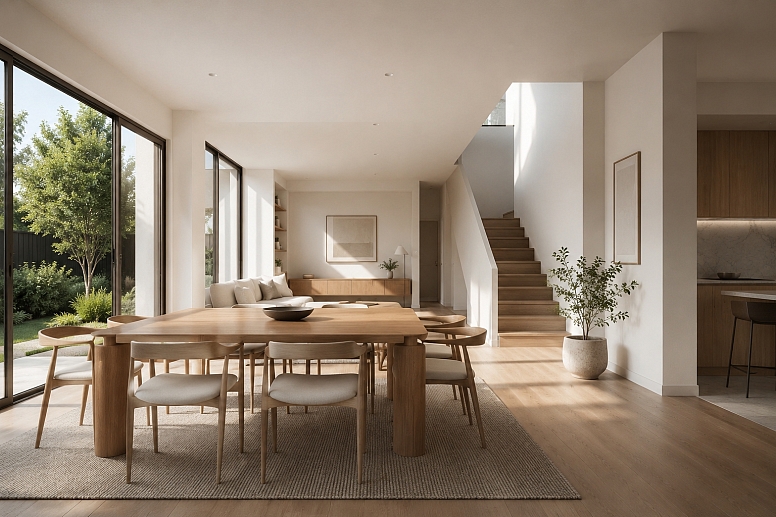
What it produces is a mood. A vibe. An aesthetic suggestion of a space that could theoretically exist somewhere, in some building, under some set of physical conditions that the AI never calculated because it doesn't calculate anything. It generates pixels that look convincing based on statistical patterns in its training data.
For a mood board, that's genuinely useful. For selling a real building to a real buyer who will move in and live there, it's something between misleading and dangerous.
The Trust Problem Nobody's Talking About
I've started noticing something in conversations with buyers and agents that I don't think existed two years ago. It's a kind of ambient scepticism about all rendered images, not just AI-generated ones.
A buyer looks at a beautiful render of an off-plan apartment, and their first instinct is no longer "I want to live there." It's "Is this real?" And by "real," they don't mean "has it been built yet"; they understand the concept of a pre-construction render. They mean: does this image actually represent the building I'm buying, or is it just a pretty picture someone typed into a chatbot?
That scepticism is rational. They've been burned. Maybe not on a property purchase specifically, but they've seen AI-generated images in enough contexts now, social media, advertising, news, to know that photorealistic doesn't mean real anymore. That instinct is bleeding into real estate.
For developers and architects who invest in legitimate, project-accurate visualization, this is a problem. Your honestly-produced render is now competing for trust against a flood of AI-generated fantasy images. The buyer can't tell the difference at a glance. So they discount everything.
This is the hidden cost of cheap AI renders in the market. They don't just mislead the people who see them. They erode trust in the entire visual language that the real estate industry depends on to sell unbuilt properties.
What AI Actually Does Well (And Where It Falls Apart)
I want to be fair here, because I'm not anti-AI. We use AI tools in our own workflow, and I think anyone in this industry who refuses to engage with them is going to fall behind.
Here's where AI is genuinely excellent. Early-stage concept exploration; generating ten different aesthetic directions for a project in an afternoon instead of a week. Mood boards and style references. Quick visualisations of colour palettes and material combinations before committing to a full 3D scene. Post-production touch-ups: sky replacement, people insertion, atmospheric effects.
These are legitimate productivity gains. A concept that used to take two days now takes two hours. That's real value.
But there's a hard line, and the industry is going to have to draw it clearly. The line is between concept and deliverable. Between "this is the feeling we're going for" and "this is what your apartment will look like."
The moment an AI-generated image crosses that line, the moment it appears in a sales brochure, on a property portal, or in a presentation centre as a representation of a specific building, it becomes a promise the building can't keep. Because the image wasn't built from the building's data. It was built from a text prompt and a statistical model.
A studio-produced render built on the project's actual 3D model, with the correct floor plan, specified materials, and accurate light simulation, is a representation. An AI image that looks similar but has no connection to the actual building is a fabrication.
Both look the same to the buyer. Only one tells the truth.
Where This Goes Next
I think we're about twelve to eighteen months away from this becoming a regulatory conversation in at least some markets. Consumer protection frameworks in the UK and EU are already tightening around AI-generated content in advertising. It's probably a matter of time before someone asks whether AI-generated "renders" in property marketing constitute a form of misleading representation.
Whether or not regulation arrives, the market will self-correct to some degree. Developers whose buyers move in and feel misled will pay the price in complaints, reputation damage, and lost referrals. Developers whose visual materials accurately represent the finished product will build trust that compounds over time.
The studios and practices that will thrive in this environment are the ones that can articulate the difference, not just in quality, but in methodology. "This image was built from your actual architectural data" is a fundamentally different statement from "this image was generated by AI based on a description of your project." Both produce beautiful images. Only one produces an accountable one.
What I Tell Architects and Developers
When someone asks me whether they should use AI for their project marketing, I say the same thing every time.
Use it upstream. Use it for concepts, for mood boards, for exploring ideas quickly. It's brilliant for that, and I'd be a hypocrite to pretend otherwise.
But when it comes to the images that will represent your building to the people who are going to buy it, live in it, and compare it to reality on the day they collect the keys, build those from the actual project data. Build them from the floor plans, the material specifications, the structural grid, and the real light conditions. Make them accurate. Make them honest.
Not because it's the more expensive option. But because it's the one that still works when the buyer walks through the door.
Architect Amanda Araujo is the founder of Render Fabrik, a studio specialising in visual production, photorealistic rendering, video tours, and 360° immersive content for residential and commercial developments. Based in Fortaleza, Brazil, the studio works with architects and developers across Brazil, the United States, Portugal, the UK, India, and Spain.
Categories
Recent Posts




0.0891