

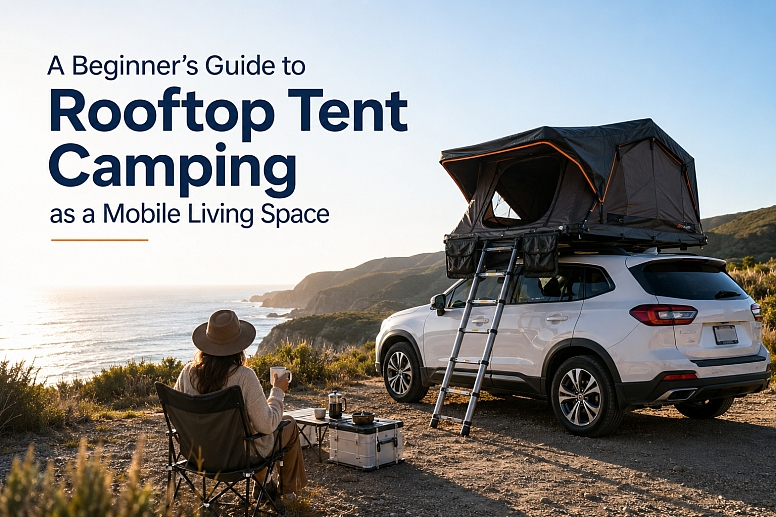
Mobile Living Space: Beginners Guide to Rooftop Tent Camping
There has been a subtle change in how people are beginning to understand space. This is not necessarily in cities or buildings themselves, but in how quickly a temporary place can feel structured enough to live in. Cars, once defined purely as transport objects, are gradually becoming part of that shift, acting as structural bases for small, mobile living systems.
Rooftop tent camping sits within this transformation. For someone encountering it for the first time, it is less about outdoor recreation and more about a simple architectural question: what happens when a vehicle starts to carry not just people, but a usable layer of living space above it?
The idea is straightforward. A roof rack becomes a foundation. A folded structure becomes an enclosed volume. And in a matter of minutes, a parked car is no longer just a vehicle; it becomes a temporary micro-dwelling positioned wherever the journey pauses.
This change is not immediately about comfort or convenience. It is about spatial logic.
When a Car Becomes a Spatial Base
Most beginners approach rooftop tent systems with practical expectations: where to install one, how it opens, and how long it takes to set up. But those questions only describe the mechanism, not the shift in how space is being reorganized.
A parked car already defines a boundary on the ground. Adding a rooftop structure introduces a second layer of occupation. Between these two layers, a small but meaningful spatial system emerges: storage below, living above, circulation in between.
This is where rooftop camping begins to resemble something closer to architectural thinking than outdoor gear usage. It is not simply about sleeping outside. It is about how a compact system reassigns function to existing surfaces without changing their primary identity.
The First Night Changes the Perception, Not the Setup
For most first-time users, the technical setup is rarely the difficult part. Roof load limits, mounting systems, or unfolding mechanisms become familiar quickly. What takes longer to adjust is the sensory shift once the structure is actually used.
Elevation changes perception. Wind behaves differently a few meters above ground. Sound disperses rather than settles. Even light from passing vehicles or nearby roads feels less intrusive, as if distance has been subtly recalibrated.
One of the most common early experiences happens not during travel, but after stopping. A vehicle is parked along a coastal pull-off or an industrial edge road outside a small town. The tent is unfolded, and within minutes, the car’s roof becomes a quiet platform separated from the ground plane.
In these moments, rooftop camping stops feeling like an activity and starts feeling like a temporary occupation of a constructed space that simply happens to be mobile.
The Entry Point Is Often Simpler Than Expected
Beginners usually overestimate the system's complexity before their first trip. The learning curve is not architectural in the strict sense, but logistical: compatibility between the vehicle and the structure, roof load awareness, and understanding how quickly the space can be deployed after hours of driving.
Brands like Naturnest are often part of this entry point, not because of specifications alone, but because they reflect a design approach centered on compact integration rather than standalone equipment thinking. In many early user experiences, systems like Naturnest rooftop tents are not described as “camping products,” but as extensions of vehicle space; an additional layer added to something already in motion.
The distinction matters because it shifts attention away from “what it does” toward “how it reconfigures existing space.”
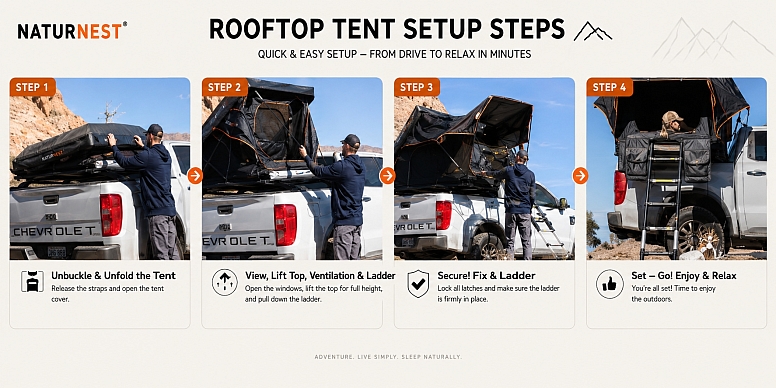
Rooftop Camping as a Temporary Dwelling Logic
At a certain point, the conversation stops being about tents entirely.
What becomes more interesting is the logic of temporary dwelling itself. A rooftop structure does not aim to replace architecture, but it introduces a simplified version of it: enclosure, elevation, separation from the ground, and controlled exposure.
In this sense, rooftop camping begins to resemble a minimal architectural system rather than an outdoor setup. It is not trying to create permanence, but it still follows spatial rules that feel familiar to built environments.
A helpful way to understand this transition is to view it as a decision-making process rather than a product choice. For those trying to understand different configurations, a structured reference like this beginner rooftop tent guide can be useful not as a buying guide, but as a breakdown of how spatial decisions are made when mobility becomes part of living structure design.
What Actually Changes After You Start Using It
The most noticeable shift does not happen during the first setup or even the first night. It appears gradually in how stops along a journey are perceived.
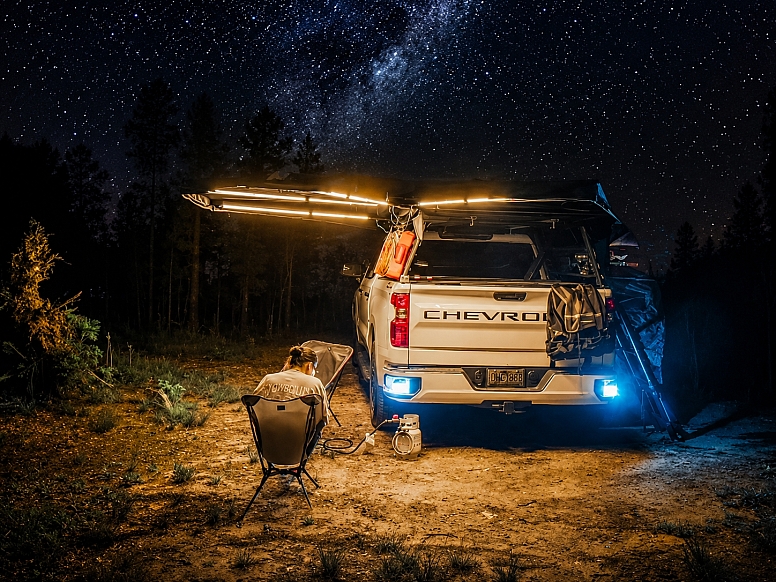
Parking lots near coastlines, rest areas beside highways, or quiet industrial edges at night begin to register differently. They are no longer interruptions in travel. They become potential spatial conditions.
A couple who used a rooftop system for short weekend trips described their early experiences not in terms of camping, but as “learning how to occupy space outside of buildings without needing a building.” Their first stop was a coastal roadside pull-off outside a small town. Nothing about the location was designed for people to stay there, yet the presence of a raised sleeping space created a temporary threshold between movement and rest.
The important detail was not the tent itself, but the way the car stopped being perceived as a vehicle during those hours.
A System Somewhere Between Infrastructure and Improvisation
Rooftop tent camping sits in a quiet middle ground. It is not infrastructure in the traditional sense, but it is not purely improvisational either. It introduces a repeatable structure into otherwise unstructured environments, without fully defining how those environments should be used.
This ambiguity is what makes it interesting from a spatial perspective. The system does not demand that a place be designed for it, yet it still produces a recognizable pattern of occupation wherever it appears.
In that sense, rooftop camping is less about escaping cities or accessing nature. It is about testing how little is needed for a space to become temporarily inhabitable, and how mobility changes the definition of “where” living actually happens.
And once that shift becomes familiar, travel stops being defined by destination. It becomes defined by the quiet possibility that wherever the car stops, a small piece of architecture can already begin.
Categories
Recent Posts






0.0973